
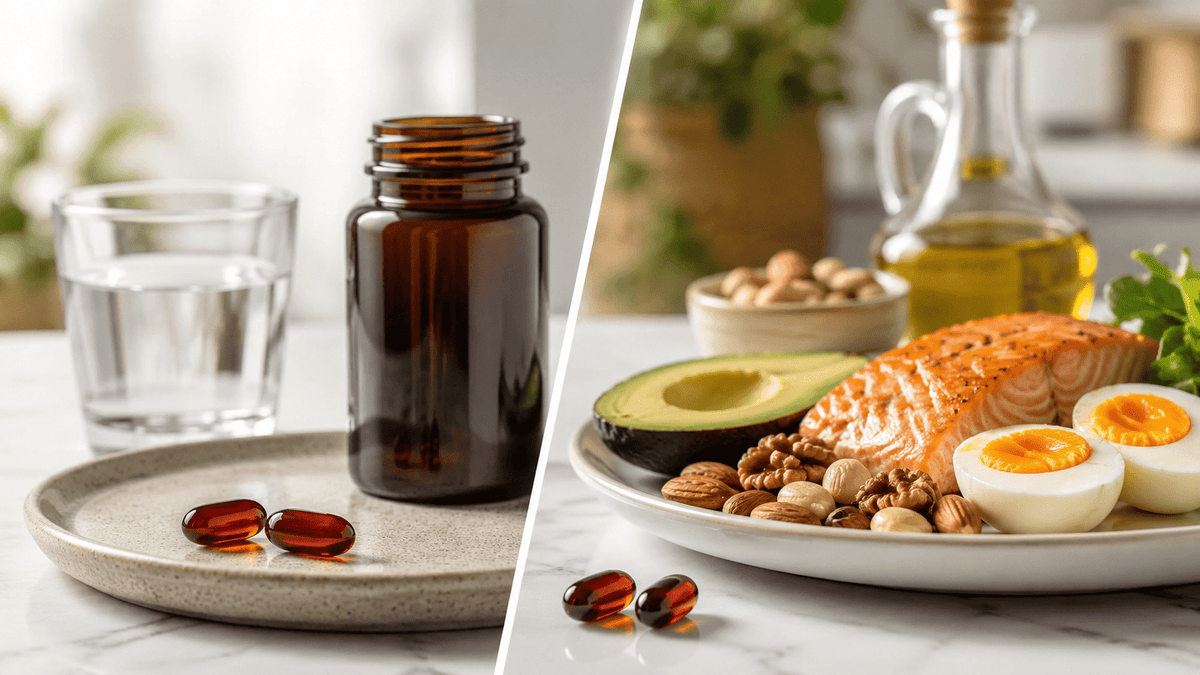
You have your CoQ10 supplement ready, but one surprisingly important question remains: should you take CoQ10 with food or on an empty stomach?
It might seem like a minor detail, yet how you take a supplement can influence how effectively your body absorbs it. CoQ10 presents an interesting case because it does not dissolve readily in water. Food, particularly dietary fat, can help create better conditions for absorption.
That does not mean you need an elaborate meal every time you take CoQ10. A normal breakfast, lunch, or dinner can work perfectly well. The trick is understanding what matters and what does not.
If you want to get more from your daily CoQ10 routine without turning supplement timing into a science project, here is what the evidence tells us.
Should You Take CoQ10 With Food?
In most cases, yes. Taking CoQ10 with food is a practical way to support its absorption, particularly when the meal contains some dietary fat.
The reason comes down to CoQ10's physical properties.
According to StatPearls, CoQ10 is a lipid-soluble molecule with a relatively large molecular weight, and its absorption from the gastrointestinal tract is slow and limited. The same medical reference notes that fatty meals can improve CoQ10 absorption.
That makes taking CoQ10 with breakfast, lunch, or dinner more than a matter of convenience. Your meal can help create an environment that favors absorption.
This does not require eating a heavy or greasy meal. Healthy everyday sources of dietary fat can do the job. Think avocado on toast, eggs at breakfast, nuts with yogurt, olive oil on a lunchtime salad, seeds in oatmeal, or fish at dinner.
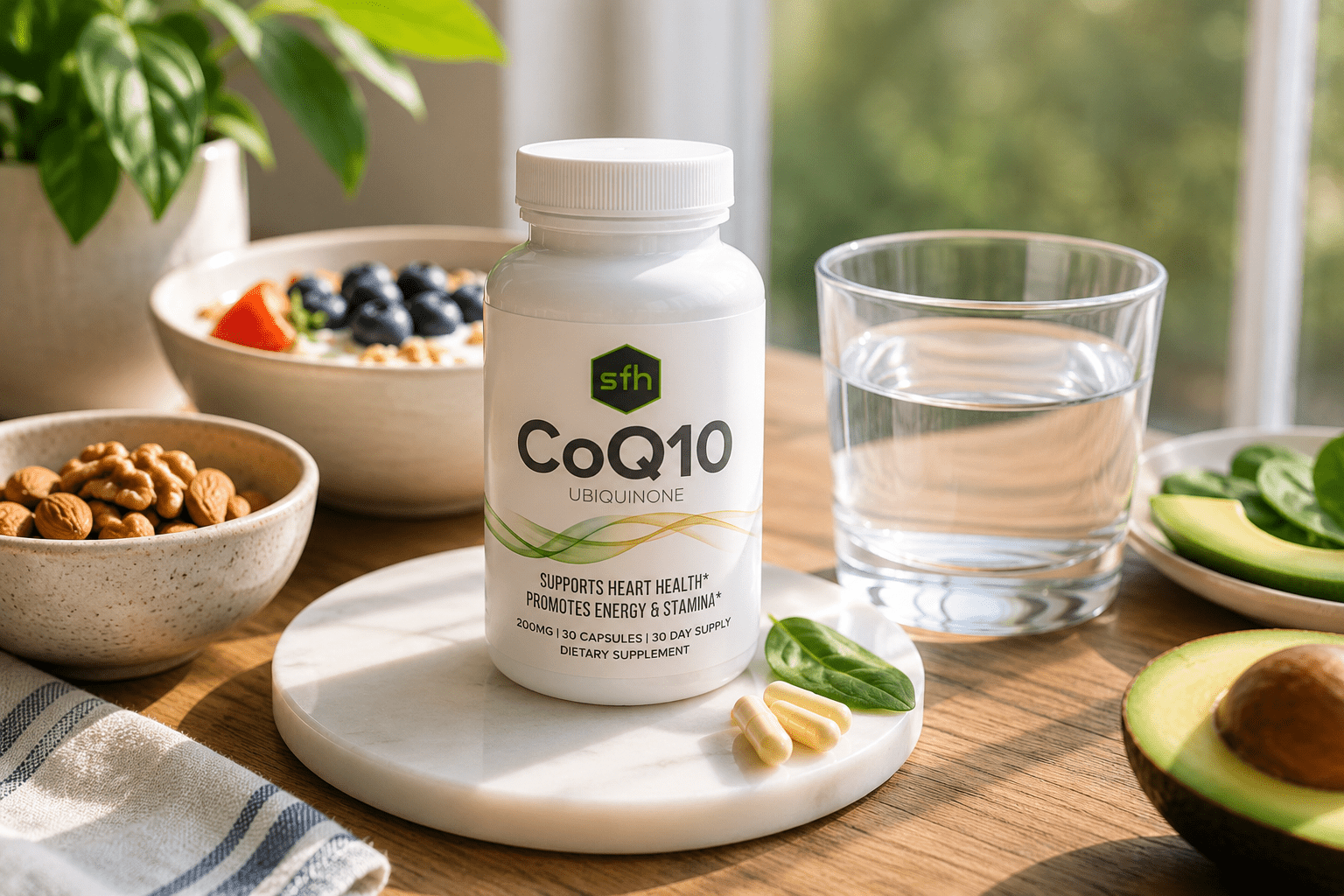
For someone using SFH CoQ10, which provides 200 mg of CoQ10 in the ubiquinone form, attaching the serving to a regular meal is a simple way to make supplementation part of an established routine while taking its fat-soluble nature into account.
Why Food Can Improve CoQ10 Absorption
CoQ10 has low water solubility. That creates a challenge because the digestive tract is largely an aqueous environment.
Researchers have therefore spent considerable time examining CoQ10 bioavailability and the factors that can influence how much reaches circulation after oral supplementation.
According to a pharmacokinetic study published in the Journal of Clinical Pharmacology and indexed by PubMed, food intake enhanced the intestinal absorption of CoQ10. The researchers also described CoQ10 absorption as slow and limited because of its hydrophobicity and large molecular weight.
This helps explain why taking CoQ10 on an empty stomach may not make the most sense when maximum absorption is the goal.
Food also stimulates digestive processes involved in handling fats. Because CoQ10 is lipid soluble, consuming it in the context of a meal can provide conditions that are more favorable for uptake than simply swallowing it with water.
Does Dietary Fat Really Matter?
Yes, although you do not need to obsess over the exact number of grams of fat in your meal.
According to StatPearls, CoQ10's bioavailability is low, and absorption can be improved when it is taken with a fatty meal.
The practical takeaway is refreshingly simple: include a reasonable source of fat.
You could pair your supplement with almond butter, walnuts, avocado, olive oil, eggs, yogurt, chia seeds, or another food that naturally contains fat. There is no need to transform breakfast into an unusually high-fat meal simply for your supplement.
Can You Take CoQ10 on an Empty Stomach?
Yes, you can take CoQ10 on an empty stomach. The issue is not that doing so is automatically dangerous. It is that an empty stomach may provide less favorable conditions for absorption.
That distinction matters.
Someone who has taken CoQ10 without food does not need to panic or assume the serving was completely wasted. Absorption still occurs. Research simply gives us a good reason to prefer taking CoQ10 with food when possible.
If you normally swallow supplements first thing in the morning before eating anything, consider moving your CoQ10 to breakfast instead. If you skip breakfast, lunch can be an equally practical option.
Consistency also matters. A theoretically perfect supplement schedule is not particularly useful if it is so complicated that you regularly forget it.
Does the Specific Meal Affect Absorption?
Interestingly, research suggests meal context can make a measurable difference.
In a human crossover study published in Journal of Nutritional Science and Vitaminology, researchers gave 13 healthy adults 120 mg of CoQ10 alongside different meals. During the first five hours after administration, the area under the serum CoQ10 concentration curve was approximately 1.5 times higher with miso soup than with the other tested foods.
That finding does not establish miso soup as the ultimate CoQ10 companion. The study was small, involving only 13 participants, so it should not be stretched into a universal recommendation.
What it does demonstrate is more interesting: the food surrounding your supplement can influence CoQ10 bioavailability.
Rather than searching for one magical food, focus on the broader principle. Take your CoQ10 alongside a balanced meal containing some dietary fat, and choose a meal that fits naturally into your day.
What Foods Work Best With CoQ10?
You do not need a special "CoQ10 diet." Instead, choose a meal you already enjoy that contains some dietary fat.
At breakfast, useful options include eggs, avocado, yogurt, nuts, seeds, or nut butter. If you prefer oatmeal, adding walnuts, chia seeds, or almond butter introduces dietary fat while making breakfast more substantial.
Lunch and dinner provide just as many possibilities. A salad dressed with olive oil, salmon with vegetables, avocado in a grain bowl, or a meal containing nuts and seeds can all provide dietary fat.
What about coffee? Taking CoQ10 alongside black coffee is not equivalent to taking it with a meal containing fat. If coffee is your morning ritual, consider taking your supplement when you actually eat breakfast instead.
This is also an easy way to use SFH CoQ10 consistently. Pairing its 200 mg ubiquinone serving with one familiar meal each day removes much of the guesswork surrounding CoQ10 timing.
Is Breakfast or Dinner Better for CoQ10?
Neither meal is automatically superior.
If breakfast contains dietary fat and you reliably eat it every morning, breakfast is an excellent choice. If your morning meal consists only of fruit or you routinely skip breakfast, lunch or dinner may provide a better opportunity.
Some people prefer taking CoQ10 earlier in the day because sleep disturbance has occasionally been reported.
According to the National Center for Complementary and Integrative Health (NCCIH), no serious side effects of CoQ10 have been reported, although mild side effects can include digestive upset and insomnia.
If taking CoQ10 with dinner works comfortably for you, there is no general rule requiring you to switch to breakfast. If you notice that evening supplementation seems to affect your sleep, however, moving it to breakfast or lunch is a sensible adjustment.
Your routine should balance absorption, comfort, and consistency.
How to Improve CoQ10 Absorption
If maximizing CoQ10 absorption is your goal, a few practical habits matter more than complicated supplement rituals.
First, take CoQ10 with food. Second, include a source of dietary fat in that meal. Third, follow the serving instructions for your specific product rather than assuming that every CoQ10 formulation should be used identically.
Formulation matters because CoQ10 has naturally challenging absorption characteristics. Ubiquinone and ubiquinol are two forms commonly encountered in supplements, and manufacturers may also use different delivery systems.
Do not assume that taking more automatically solves an absorption problem. More is not necessarily better, and your appropriate intake depends on your circumstances.
A product such as SFH CoQ10, providing 200 mg of ubiquinone, can simply be incorporated into a regular meal-based supplement routine according to its label directions. That approach is easier to maintain than constantly changing timing in search of marginal improvements.
Who Should Be Careful When Taking CoQ10?
For many healthy adults, CoQ10 is generally well tolerated. However, supplement safety is about more than whether something causes an upset stomach.
Medication interactions deserve particular attention.
According to the Mayo Clinic, CoQ10 appears to be generally safe with few side effects, but it may make the anticoagulant warfarin less effective. Mayo Clinic also advises discussing CoQ10 with a healthcare professional, particularly when medications or medical treatment are involved.
If you take prescription medication, simply separating your medicine and CoQ10 by a few hours should not be assumed to eliminate an interaction. Your doctor or pharmacist can advise whether CoQ10 is appropriate for you and how it should be scheduled.
People who are pregnant, breastfeeding, receiving treatment for a health condition, or preparing for medical procedures should also seek individualized professional guidance before adding supplements.
Frequently Asked Questions
Should CoQ10 be taken with food?
Yes, taking CoQ10 with food is generally preferred when absorption is the priority. CoQ10 is lipid soluble, and research indicates that food and dietary fat can improve its absorption.
Can I take CoQ10 on an empty stomach?
You can, but it may not provide ideal conditions for absorption. Taking CoQ10 with a regular meal containing some dietary fat is usually a more practical approach.
What foods help CoQ10 absorb better?
Foods containing healthy fats are sensible choices. Examples include avocado, nuts, seeds, olive oil, eggs, yogurt, nut butter, and fatty fish. You do not need an exceptionally high-fat meal.
Is CoQ10 better with breakfast or dinner?
Either can work. Choose a meal containing dietary fat that you eat consistently. If evening CoQ10 seems to interfere with your sleep, breakfast or lunch may be more comfortable.
Can I take 200 mg of CoQ10 with one meal?
A 200 mg serving can be taken with a meal when that matches the directions for your particular supplement. Individual needs vary, so follow the product label and seek professional advice when medications or health conditions are involved.
Conclusion
So, should you take CoQ10 with food or on an empty stomach? If absorption is your priority, food wins. CoQ10 is lipid soluble and has naturally limited oral bioavailability, while research shows that food and dietary fat can support its absorption.
Fortunately, optimizing your routine does not require complicated meal planning. Choose a breakfast, lunch, or dinner containing some dietary fat and make that meal your regular CoQ10 time. Avocado, nuts, seeds, eggs, yogurt, olive oil, or fish can all fit the bill.
Most importantly, aim for a routine that is practical enough to maintain. CoQ10 timing should support your wellness habits, not complicate them. Combine sensible meal timing with label directions and appropriate professional guidance, and you have a simple, evidence-informed approach to daily CoQ10 supplementation.

Leave a comment
This site is protected by hCaptcha and the hCaptcha Privacy Policy and Terms of Service apply.