

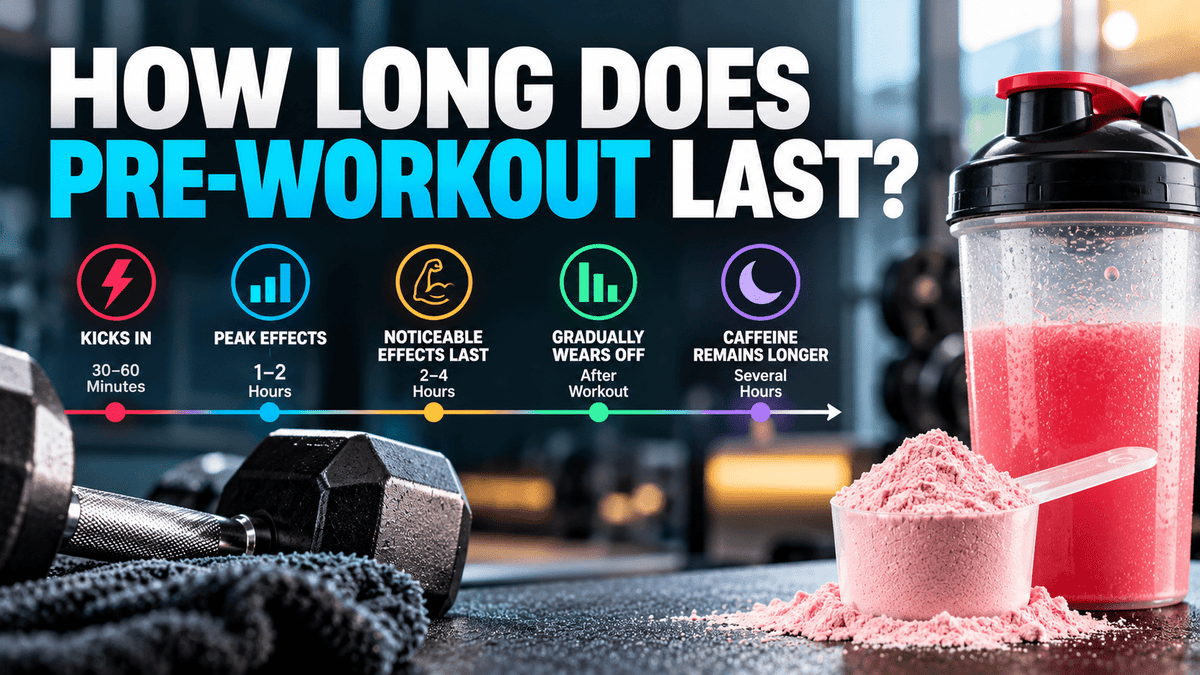
The best time to take pre-workout depends on what is in the formula, how quickly you respond to its ingredients, and when you want those effects during training. For many caffeinated products, taking pre-workout about 30 to 60 minutes before exercise is a practical starting point. However, that does not mean every product should be taken at exactly the same time. Caffeine has an acute effect, while ingredients such as beta-alanine and creatine work through different processes that are less dependent on the exact minute you take them. Your workout schedule matters too.
Morning training, afternoon sessions, and late evening workouts can call for different approaches, especially when caffeine is involved. Food, personal tolerance, the amount of caffeine in your serving, and your normal sleep schedule can also change what works best. Understanding these factors makes pre-workout timing much easier and helps you build a routine.
When Should You Take Pre-Workout?
For a typical caffeinated pre-workout, 30 to 60 minutes before exercise is a reasonable range. The International Society of Sports Nutrition identifies 60 minutes before exercise as the most commonly used timing for caffeine supplementation and notes that the best timing can depend on the form of caffeine and individual response.
That makes 60 minutes a useful reference point, not a rigid rule. If your formula contains a moderate caffeine dose and you respond quickly, 30 minutes may fit your routine well. If you want the stimulant effect developing before your first working set, you may prefer a little more time.
How Long Before a Workout Should You Take Pre-Workout?
Think about timing as a window rather than a single perfect number. Taking pre-workout 15 minutes before training may be reasonable for some formulations, but a conventional caffeine product may not have reached its strongest effect yet. Thirty minutes gives the ingredients more time to take effect, while 60 minutes matches a commonly studied caffeine interval.
A randomized crossover trial compared caffeine consumption two hours, one hour, and 30 minutes before exercise in resistance-trained men and women. The study used 6 mg per kilogram of caffeine and found that the one-hour condition produced the most consistent improvements across the lower-body performance measures assessed.
The finding does not mean one hour is automatically best for everyone. The study used a specific dose and controlled exercise protocol, while commercial pre-workouts vary considerably. Your own response still matters.
Does Pre-Workout Timing Affect Performance?
Timing can matter because supplementation is intended to place relevant ingredients in the body when they can support the exercise being performed.
A randomized, placebo-controlled crossover study found that a supplement containing 200 mg of caffeine consumed 35 minutes before exercise produced 5% greater total work during a subsequent fatiguing time trial than placebo. The same improvement was not found when it was consumed at exercise onset or immediately before the time trial.
The result is useful because it shows that timing can influence the effect of an acute caffeine dose. It should not be turned into a promise that taking any pre-workout 35 minutes before training will improve performance by 5%. The participants, caffeine amount, supplement, and exercise protocol were specific to that study.
Does Pre-Workout Timing Depend on Caffeine?
Often, yes. Caffeine is usually the ingredient that makes timing most important because it can influence alertness and exercise performance soon after consumption.
Check the caffeine amount per serving before deciding when to take a product. Also count other caffeine you consume during the day, including coffee, tea, energy drinks, and other supplements.
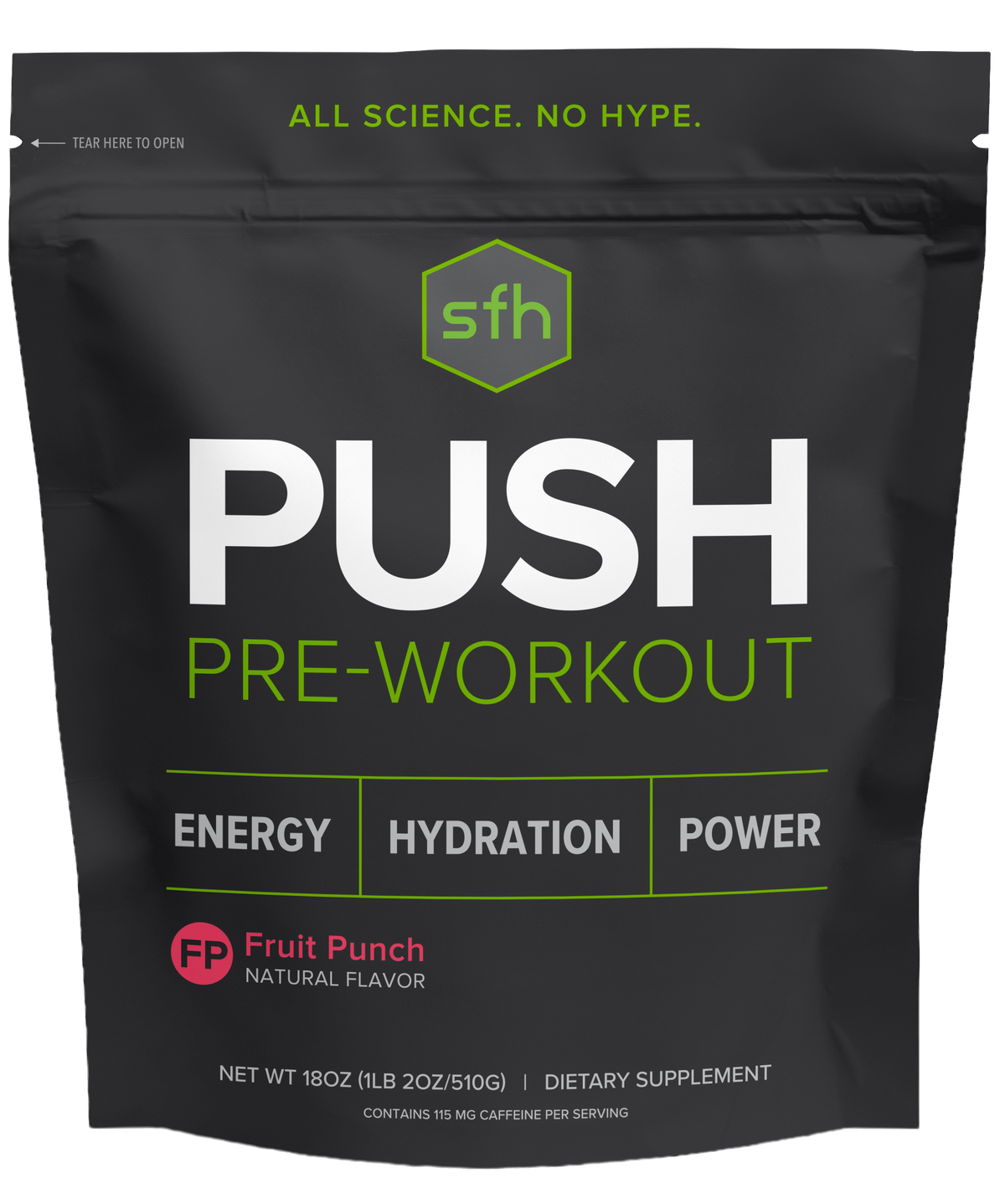
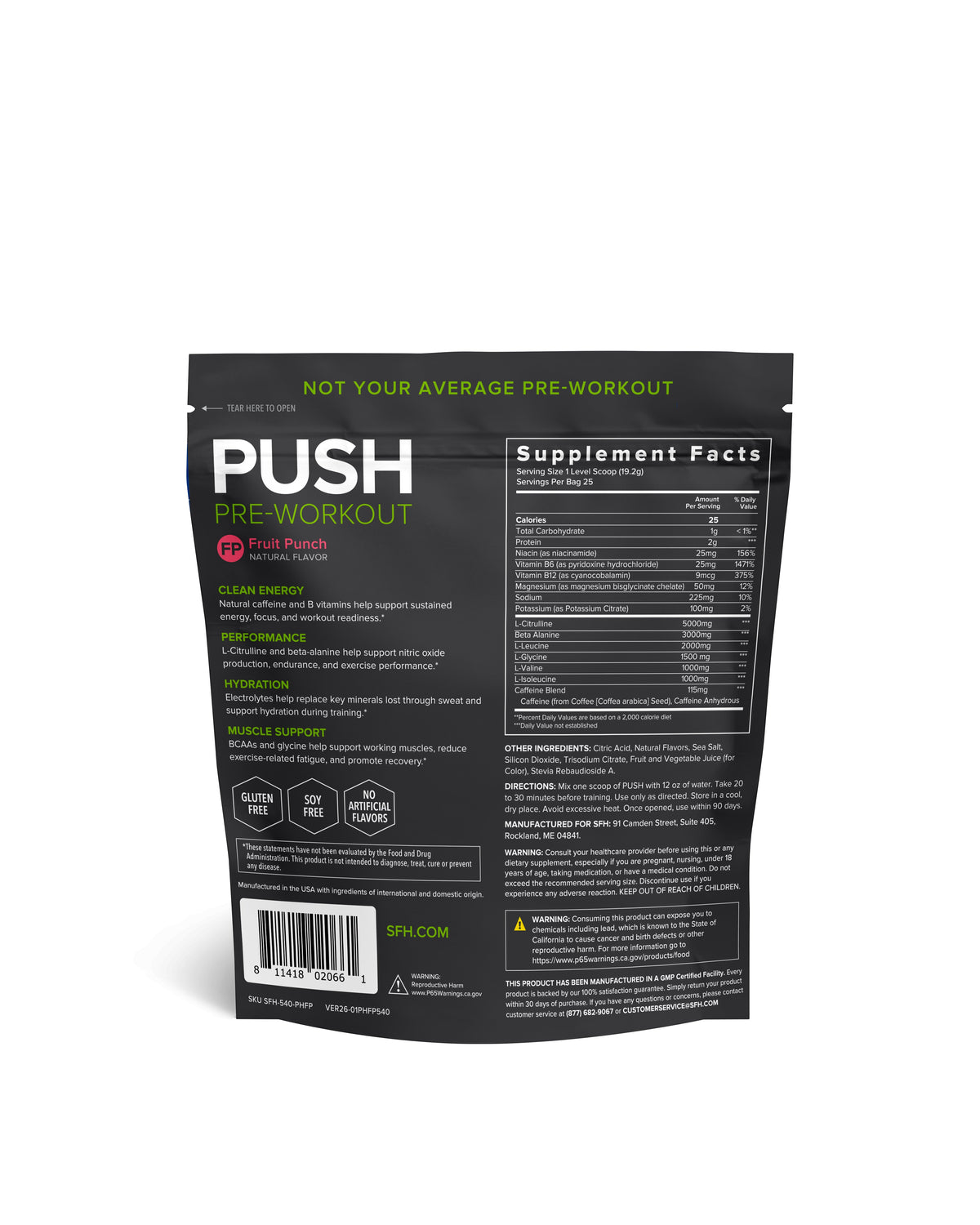
SFH Push, for example, contains 115 mg of caffeine per serving, so its timing can be considered alongside the amount of caffeine provided by the serving. Looking at the actual formula is more useful than assuming every pre-workout has the same strength.
Caffeine can also feel different depending on your usual intake. Someone who rarely consumes caffeine may notice a serving much more strongly than someone who regularly drinks coffee or other caffeinated beverages.
Should You Take Pre-Workout on an Empty Stomach?
There is no universal requirement to take pre-workout on an empty stomach. Some people prefer it because they dislike exercising soon after a large meal, while others find concentrated supplements uncomfortable without food.
If you have eaten a substantial meal shortly before training, you may not want to add a full serving immediately afterward. On the other hand, if you train early and have not eaten, taking pre-workout before breakfast may fit your routine.
The goal is not to make fasted supplementation a rule. It is to find a routine that lets you train comfortably while following the product's serving directions.
When Should You Take Pre-Workout After Eating?
Your meal can influence how you plan your routine, but there is no single waiting period that applies to everyone.
A large meal can feel very different from a small snack. If eating close to exercise makes you feel heavy, give yourself more time between food and training. If you tolerate a light snack well, your schedule can be more flexible.
A practical approach is to work backward from your workout. If you want to take pre-workout 30 to 60 minutes before exercise, plan your meal or snack so you are not consuming everything at once.
This is mainly about comfort and routine rather than finding a magical absorption window.
When Should You Take Pre-Workout at Night?
Evening training requires more caution when your pre-workout contains caffeine.
A systematic review and meta-analysis of 24 studies found that caffeine reduced total sleep time by about 45 minutes and reduced sleep efficiency by 7%. The researchers estimated that a standard pre-workout serving containing 217.5 mg of caffeine would need to be consumed at least 13.2 hours before bedtime to avoid reducing total sleep time according to their analysis.
The 13.2-hour estimate should not be treated as a personal cutoff for everyone. It came from the researchers' analysis and reflects a particular modeled serving. Individual responses and product doses differ.
The practical lesson is that late caffeine deserves attention. A serving that feels manageable in the afternoon may be less suitable late at night if you need to sleep soon afterward.
How Long Before Bed Should You Stop Taking Pre-Workout?
There is no single cutoff that guarantees good sleep for everyone, but caffeinated pre-workout should be treated carefully as bedtime approaches.
A controlled study found that 400 mg of caffeine significantly disrupted sleep even when participants consumed it six hours before going to bed. The finding shows why no longer feeling strongly stimulated does not necessarily mean caffeine has stopped affecting you.
The dose used in that experiment was higher than many moderate pre-workout servings, so it should not be applied as though every product produces the same effect. Still, if you regularly struggle to sleep after evening workouts, moving caffeinated pre-workout earlier or choosing a lower-caffeine option is reasonable to consider.
When Should You Take Beta-Alanine in Pre-Workout?
Beta-alanine does not need to be timed like caffeine. Its main purpose is to increase muscle carnosine through consistent supplementation, so the exact minute you consume it before exercise is less important than regular use.
If beta-alanine is included in your pre-workout, taking the product before training is convenient. However, you should not assume that taking it earlier creates a stronger immediate effect. The tingling some people experience is not a measure of performance benefit either.
This distinction matters when reading a pre-workout label. One ingredient may influence how you feel during the next hour, while another is included because of adaptations that develop over repeated use.
When Should You Take L-Citrulline Before a Workout?
L-citrulline is commonly included in pre-workout formulas because it has been studied in relation to exercise performed after supplementation. However, there is no universal minute that guarantees the best result.
Research protocols differ in dose, timing, exercise type, and participants. If L-citrulline is part of your pre-workout, following the product's serving instructions is a sensible starting point.
The key is not to treat L-citrulline as though it follows caffeine's timeline. It does not need to produce an obvious sensation for it to be relevant to the formula.
When Should You Take Creatine in a Pre-Workout?
Creatine should not be judged by immediate pre-workout timing. Its purpose is to increase and maintain muscle creatine stores through regular supplementation.
If a pre-workout contains creatine, taking it before training can be convenient, but you do not need to expect the creatine to suddenly "kick in" 30 minutes later. Consistency matters more than trying to hit an exact minute before your first set.
That is also why creatine can fit into a daily routine at different times. The important factor is maintaining consistent intake rather than chasing an acute sensation.
Should You Take Pre-Workout Every Day?
You do not necessarily need pre-workout before every workout. Whether regular use makes sense depends on the formula, your training schedule, and how much caffeine you already consume.
Some people may reserve caffeinated pre-workout for demanding sessions while using less caffeine on easier days. There is also little reason to take a stimulant-based product on a rest day simply because it is part of your normal gym routine.
If you feel unable to train without pre-workout, look at sleep, recovery, nutrition, hydration, and overall training load as well. A supplement can support a strong routine, but it cannot replace those foundations.
What Is the Best Time to Take Pre-Workout?
For most caffeinated pre-workouts, 30 to 60 minutes before exercise is a sensible starting range. Sixty minutes is commonly studied for caffeine, while shorter intervals can work with some caffeine-containing supplements.
The best timing lines up the effects with your workout. Morning and afternoon sessions are easier to schedule, while evening training requires more attention to caffeine and sleep.
Not every ingredient follows the same timeline. Caffeine has an acute effect, while beta-alanine and creatine depend more on consistent use. L-citrulline has its own considerations.
Follow the label, keep the serving consistent, notice how you respond, and avoid increasing the amount because the effects do not appear immediately. Good timing should support training and fit into your day.
Frequently Asked Questions
Is 30 minutes before a workout enough?
It can be. Thirty minutes is a practical timing option for many caffeinated pre-workouts, although the ideal interval depends on the formula and individual response.
Is one hour before a workout too early?
Not necessarily. One hour is a commonly studied caffeine timing and may allow the effects to develop before training.
Can I take pre-workout immediately before exercising?
You can, but a conventional caffeinated product may not have reached its strongest noticeable effect when you begin. Timing also depends on the ingredients and caffeine source.
Should I take pre-workout before or after eating?
Either can work depending on your tolerance and schedule. Some people prefer training after a period without a large meal, while others are more comfortable eating beforehand.
Can I take pre-workout at night?
You can, but caffeinated products may interfere with sleep. If you train close to bedtime, consider the caffeine content and your individual sensitivity.
Conclusion
When should you take pre-workout? For a typical caffeinated formula, 30 to 60 minutes before exercise is a sensible starting range, with 60 minutes serving as a commonly researched benchmark for caffeine. Timing should still be treated as a flexible part of your routine rather than a rigid prescription. The formula, serving size, caffeine source, meal timing, training style, individual response, and bedtime can all matter.
Caffeine is usually the ingredient that makes precise timing most relevant, while beta-alanine and creatine depend more heavily on consistent use than on an exact pre-workout window. L-citrulline has its own considerations as well. If you train in the evening, protecting sleep deserves particular attention because caffeine can remain relevant after the noticeable energy has faded.
Rather than chasing the possible sensation, aim for a timing routine that feels comfortable, supports the workout you want to complete, and fits the rest of your day for long-term consistency. That approach is more practical than assuming every pre-workout needs to be taken at exactly the same time successfully.

Leave a comment
This site is protected by hCaptcha and the hCaptcha Privacy Policy and Terms of Service apply.