
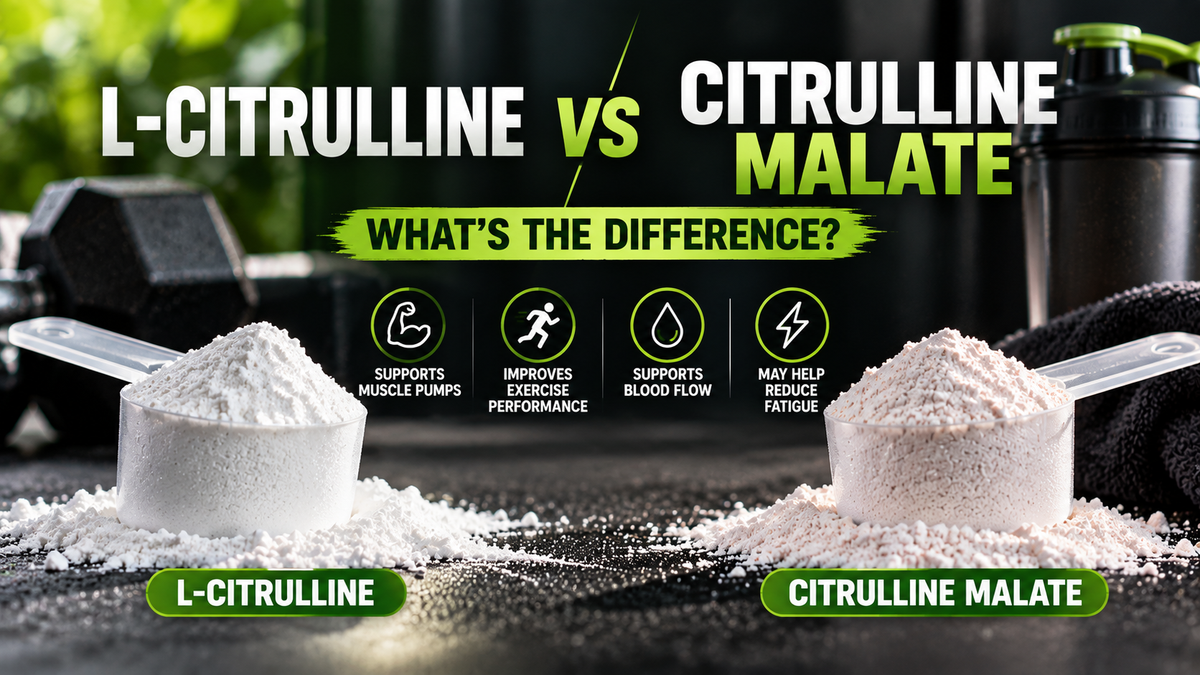
If you are comparing pre-workout supplements, you have probably seen both L-citrulline and citrulline malate on ingredient labels. They sound almost identical, but they are not the same supplement. L-citrulline is the amino acid itself, while citrulline malate combines citrulline with malate. That difference becomes important when you compare serving sizes because the total grams of citrulline malate do not represent the same amount of pure L-citrulline. Both forms are connected to the nitric oxide pathway, which is why they are popular in sports nutrition and pre-workout formulas.
However, adding malate does not automatically make citrulline more effective. Research has produced mixed results, with some studies reporting improvements in particular exercise outcomes and others finding no meaningful advantage. Understanding the composition, ratio, dosage, timing, and evidence behind each form can help you compare them more accurately and choose a formula that genuinely fits your training goals and supplement preferences today.
What Is the Difference Between L-Citrulline and Citrulline Malate?
The main difference is what the supplement actually contains.
L-citrulline is the amino acid itself. Your body can convert it into L-arginine, which is then involved in nitric oxide production. Nitric oxide plays an important role in vascular function because it helps regulate the relaxation of blood vessels. This is one reason L-citrulline has become a common ingredient in pre-workout products.
Citrulline malate combines L-citrulline with malate. Malate is associated with malic acid and participates in cellular metabolic pathways. Consequently, the total weight of a citrulline malate serving includes both components.
A 2020 review examining human research found that oral L-citrulline and citrulline malate can increase plasma citrulline and arginine concentrations. However, the researchers also noted that evidence for immediate improvements in vasodilation and skeletal muscle perfusion was inconsistent.
That distinction is important because a measurable change in an amino acid or metabolite does not automatically translate into better exercise performance. In practical terms, the two supplements share a foundation, but the amount of actual citrulline you receive can differ considerably.
Is L-Citrulline the Same as Citrulline Malate?
No. They are related, but they are not interchangeable gram for gram.
When a label says L-citrulline, the listed amount refers directly to the amino acid. If a label says citrulline malate, the listed amount refers to the combined material.
That difference can easily create confusion. An eight-gram serving of pure L-citrulline would contain eight grams of L-citrulline. An eight-gram serving of citrulline malate would contain less than eight grams of L-citrulline because some of the serving consists of malate.
The ratio between those ingredients therefore becomes particularly important when you are comparing products.
What Is L-Citrulline?
L-citrulline is a naturally occurring amino acid that participates in the body's urea cycle and can be converted into L-arginine. L-arginine is used by nitric oxide synthase to produce nitric oxide.
That metabolic relationship explains much of L-citrulline's interest in sports nutrition. Rather than acting as a stimulant, L-citrulline is primarily associated with the pathway that supports nitric oxide availability and vascular function.
Research has also suggested that citrulline may be an efficient way to increase circulating arginine. A review published in Acta Physiologica explains that L-citrulline has high intestinal absorption and relatively low first-pass metabolism, while oral L-arginine is more heavily affected by metabolism in the gut and liver.
As a result, citrulline can be an effective precursor for increasing systemic arginine availability. This helps explain why supplement manufacturers frequently use L-citrulline rather than simply adding L-arginine.
What Is Citrulline Malate?
Citrulline malate is a combination of L-citrulline and malate. The citrulline portion provides the amino acid discussed above, while malate brings a second compound into the formulation.
The addition of malate has attracted interest because malate is involved in cellular energy metabolism. Researchers have therefore investigated whether combining the two ingredients could provide benefits beyond citrulline alone.
However, the existence of a plausible mechanism does not prove that citrulline malate produces better results.
A 2021 critical review of citrulline malate and exercise performance found considerable differences between studies in supplement composition, dose, timing, exercise protocols, and participant characteristics.
The authors concluded that the evidence was difficult to interpret consistently and that more controlled research was needed. That is an important point when evaluating claims about citrulline malate.
What Does the Malate in Citrulline Malate Do?
Malate is involved in metabolic processes that help cells handle energy. Because exercise increases energy demands, researchers have considered whether providing additional malate alongside citrulline could influence performance.
The theory is reasonable, but the evidence is not strong enough to say that malate consistently makes citrulline more effective.
A 2026 systematic review and three-level meta-analysis examined 30 randomized controlled trials involving 644 participants. The researchers found a small overall improvement in exercise performance with citrulline malate, but they also reported wide prediction intervals, limited statistical power, and low to very low certainty of evidence. Their analysis did not establish reliable differences based on sex, training status, dosage, or timing.
That creates a more useful interpretation. Citrulline malate may help performance in some circumstances, but the evidence does not show that the malate component universally provides an additional performance advantage.
What Does 2:1 Citrulline Malate Mean?
A 2:1 citrulline malate ratio means that the formulation contains two parts citrulline for every one part malate by weight.
If a product genuinely contains an accurate 2:1 ratio, approximately two-thirds of the total powder is citrulline.
For example, eight grams of true 2:1 citrulline malate would theoretically contain about 5.33 grams of citrulline and 2.67 grams of malate.
This is why you cannot compare an eight-gram serving of citrulline malate directly with an eight-gram serving of pure L-citrulline. The latter provides eight grams of the amino acid, while the former provides considerably less.
The ratio is therefore not a minor detail. It changes how much actual citrulline you receive.
How Much L-Citrulline Is in Citrulline Malate?
The answer depends on the stated ratio and whether the product actually matches that ratio.
A 2018 study used nuclear magnetic resonance spectroscopy to analyze commercial products marketed as having a 2:1 citrulline-to-malate ratio. Four of the products tested had measured ratios ranging from approximately 1.51:1 to 1.62:1, while another was closer to the stated ratio at 1.92:1.
This does not mean that every citrulline malate product is inaccurately labeled. It does show why consumers should not assume that every product marketed as 2:1 contains exactly the same proportion of citrulline.
A critical review subsequently discussed this issue and emphasized that differences in the actual citrulline-to-malate ratio can affect how much citrulline a serving delivers. When comparing products, therefore, the ratio and the manufacturer's labeling matter more than the headline serving size alone.
Is L-Citrulline Better Than Citrulline Malate?
There is no strong evidence that L-citrulline is universally better than citrulline malate.
Pure L-citrulline has one obvious practical advantage: the amount listed on the label directly tells you how much L-citrulline the serving contains. With citrulline malate, you need to know the ratio before you can estimate the actual citrulline content.
Citrulline malate may still appeal to people who prefer that formulation, particularly because it has been investigated in resistance-training research.
The more useful question is not simply which name sounds better. It is whether the product provides an amount and form that make sense for your intended use.
Does Citrulline Malate Work Better Than L-Citrulline?
Direct research provides an important answer here.
A randomized, double-blind, placebo-controlled crossover trial involved 43 young, trained adults. Participants consumed either placebo, 5.3 grams of L-citrulline, or 5.3 grams of L-citrulline plus 2.7 grams of malate 45 minutes before exercise.
The researchers found no significant differences between the treatments for maximal neuromuscular performance, ballistic strength, strength endurance, perceived exertion, or emotional responses.
That study does not prove that citrulline malate can never outperform L-citrulline. It shows that adding malate did not create a measurable advantage under the specific conditions tested. That distinction is important because supplement claims often turn one proposed mechanism into a universal performance promise.
Is L-Citrulline or Citrulline Malate Better for Exercise Performance?
The answer depends partly on what you mean by “performance.”
A 2021 systematic review and meta-analysis examined eight studies involving 137 participants and investigated citrulline malate before resistance exercise. Across the included studies, citrulline malate was associated with an increase in repetitions performed before voluntary muscular failure. The researchers estimated the improvement at approximately 6.4 percent.
That sounds encouraging, but it should not be interpreted as evidence that citrulline malate automatically increases maximum strength.
A separate systematic review and meta-analysis examined four randomized controlled trials involving resistance-trained adults and found no significant overall effect of citrulline malate supplementation on muscle strength. These findings can coexist because repetitions to failure and maximum strength are different outcomes. A supplement might influence one measure without meaningfully changing another.
Does L-Citrulline or Citrulline Malate Give a Better Muscle Pump?
Both forms supply citrulline, so both are connected to the same underlying nitric oxide pathway.
The reason this matters for the muscle pump is that nitric oxide contributes to vascular regulation and blood vessel relaxation. During resistance training, increased blood flow and fluid movement into working muscles can contribute to the temporary feeling of fullness commonly described as a pump.
That does not mean citrulline malate has been proven to produce a better pump than L-citrulline.
A review of nitric oxide precursor supplements describes L-citrulline as an effective precursor of L-arginine and explains how nitric oxide can influence vascular function and mechanisms relevant to skeletal muscle performance.
The pump itself is also affected by training volume, repetitions, rest periods, hydration, carbohydrate intake, and the muscle being trained. A stronger pump should not be treated as proof of greater long-term muscle growth.
Which Is Better for Pre-Workout, L-Citrulline or Citrulline Malate?
Both forms can fit into a pre-workout formula, but the label needs to be read differently.
With pure L-citrulline, the listed amount directly represents the amount of citrulline provided. With citrulline malate, you need to consider the ratio before comparing it with another product.
The rest of the formula also matters. A pre-workout may combine citrulline with caffeine, beta-alanine, electrolytes, BCAAs, or other ingredients that serve different purposes.
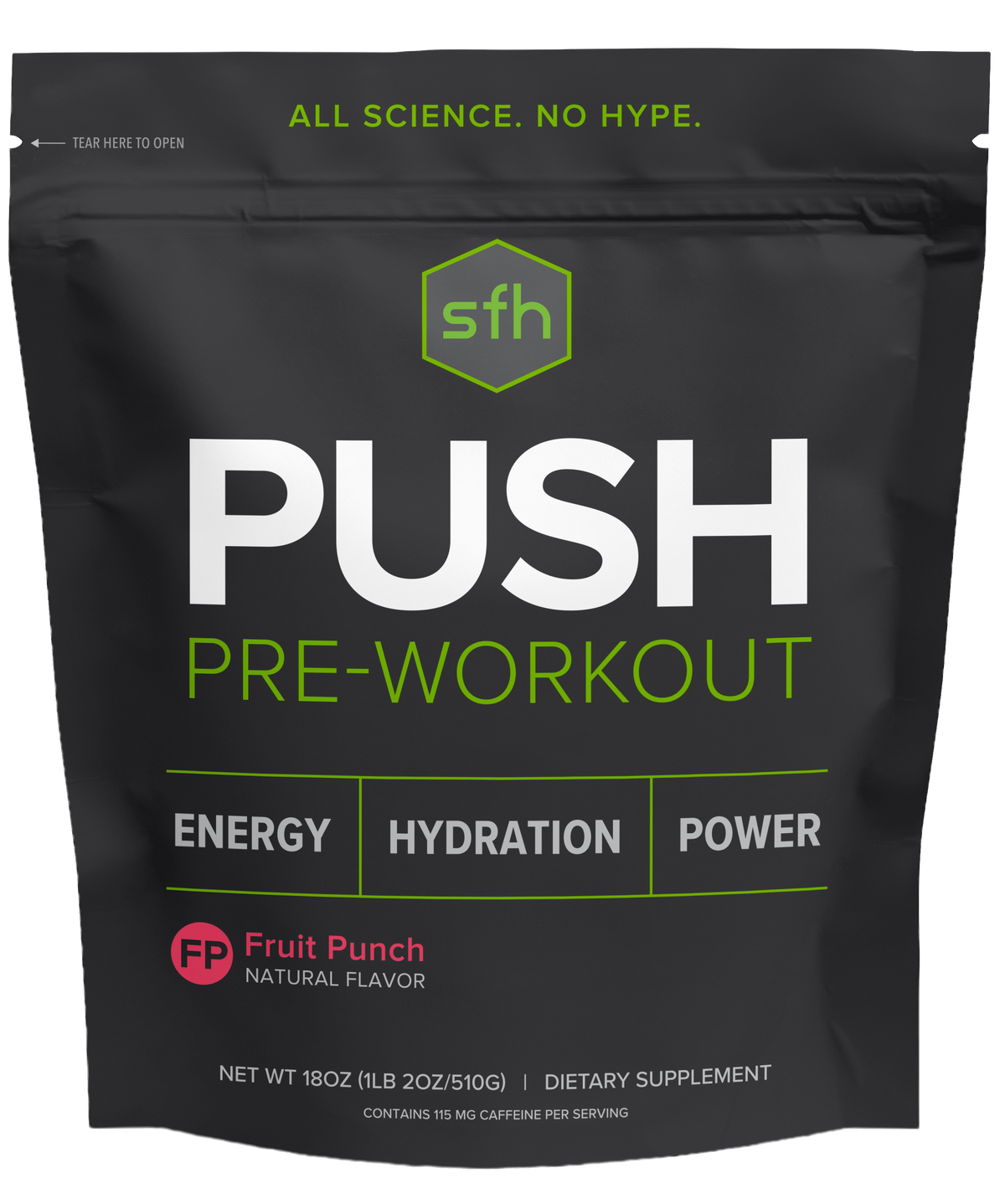
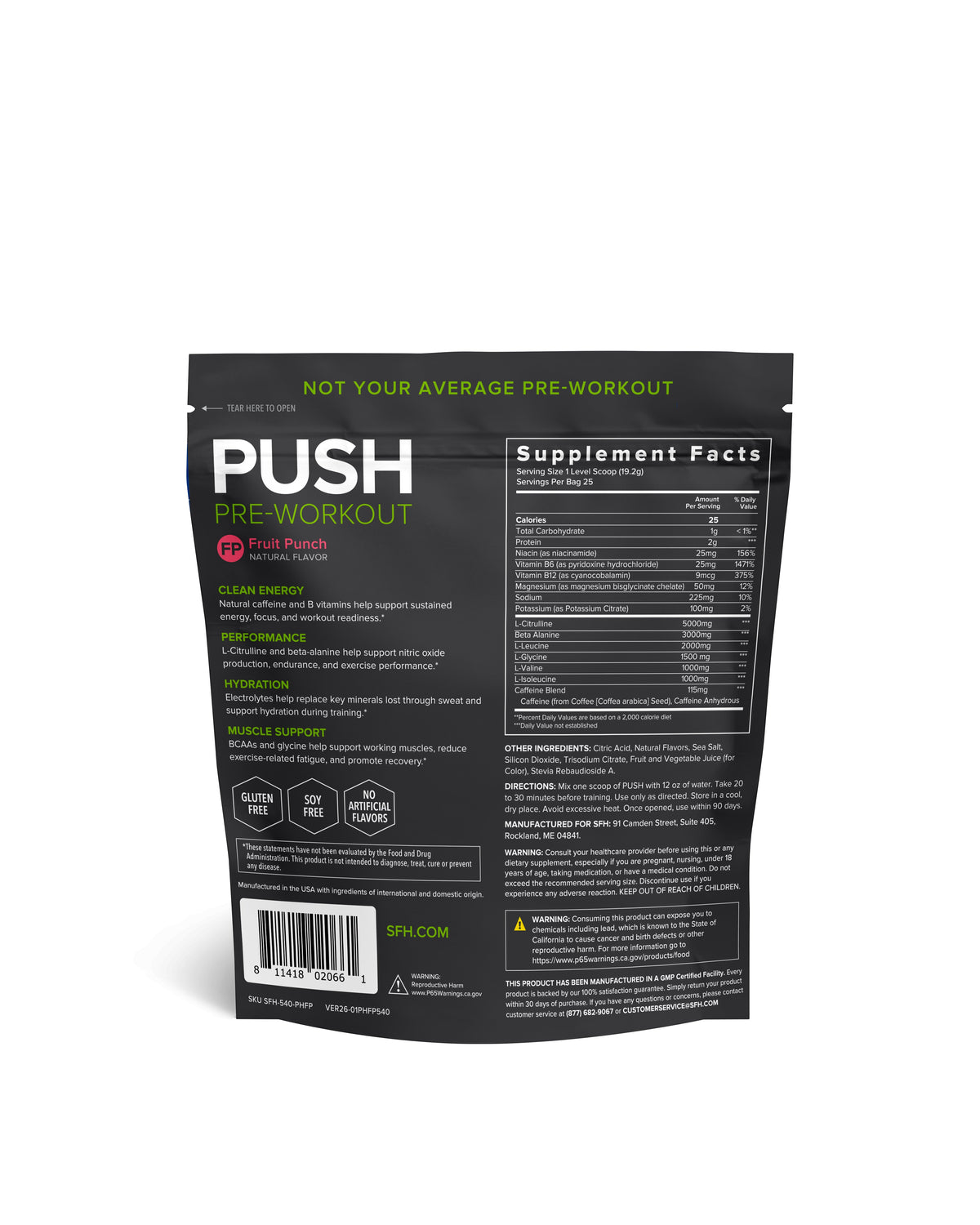
For example, SFH Push provides 5 grams of L-citrulline per serving. Because that amount is listed as L-citrulline rather than total citrulline malate, it is straightforward to identify when comparing the formula with products that use pure citrulline.
The important point is transparency. A bigger serving number does not necessarily mean more citrulline.
How Much L-Citrulline Should You Take Before a Workout?
There is no single dose that applies to every person or every purpose.
Research on citrulline supplementation has used different doses and protocols. For resistance exercise, one meta-analysis found that the studies showing improvements with citrulline malate commonly used six to eight grams approximately 40 to 60 minutes before exercise.
That does not mean six to eight grams is a universal recommendation, especially because the amount of actual L-citrulline depends on the citrulline-malate ratio.
If you use a supplement, follow the manufacturer's serving instructions rather than trying to recreate a research protocol without knowing the formulation.
How Much Citrulline Malate Should You Take Before a Workout?
Several resistance-training studies have investigated six to eight grams of citrulline malate before exercise, but the total powder amount should always be considered alongside the ratio.
For example, eight grams of a genuine 2:1 formulation would theoretically provide about 5.33 grams of citrulline. An eight-gram 1:1 formulation would provide about four grams.
The difference is substantial enough to matter when comparing products.
The newer 2026 evidence also found that optimal citrulline-malate dosing has not been firmly established. Researchers reported no reliable performance differences based on dosage or timing across their subgroup analyses. So, rather than assuming that more powder equals a better outcome, evaluate the actual citrulline content.
When Should You Take L-Citrulline or Citrulline Malate?
For acute pre-workout use, both forms are commonly consumed before exercise.
Many citrulline-malate studies have used approximately 40 to 60 minutes before training. However, this should be understood as the protocol used in research rather than a guaranteed optimal window for every individual.
The purpose of supplementation also matters. An acute pre-workout study asks a different question from a longer supplementation study investigating vascular or other outcomes.
For that reason, there is no need to treat one specific minute as a magic cutoff. Following the product directions and considering the overall supplement routine is a more practical approach.
Is Citrulline Malate Safe?
Citrulline malate has been investigated in human exercise studies, but “safe” should not be interpreted as “appropriate for everyone.”
Citrulline can influence pathways involved in nitric oxide and vascular function. A clinical pharmacology review explains that citrulline can increase arginine availability and has been investigated for effects related to cardiovascular function, although the clinical implications vary considerably between populations and study settings.
Anyone taking prescription medication, particularly medication that affects blood pressure or vascular function, should speak with a healthcare professional before using concentrated citrulline supplements. People with medical conditions should also seek individualized advice rather than assuming that a sports supplement is appropriate simply because it is widely available.
Frequently Asked Questions
Is L-citrulline the same as citrulline malate?
No. L-citrulline is the amino acid itself, while citrulline malate combines L-citrulline with malate. The total gram amounts therefore cannot be compared directly.
What does 2:1 citrulline malate mean?
It means two parts citrulline for every one part malate by weight. If the ratio is accurate, approximately two-thirds of the total powder is citrulline.
Which is better for a pre-workout?
Neither form has been established as universally superior. Compare the actual citrulline content, stated ratio, complete ingredient profile, serving size, and intended use.
Does citrulline malate give a better pump?
There is not strong evidence that citrulline malate consistently produces a better pump than an equivalent amount of L-citrulline. Both provide citrulline and connect to the nitric oxide pathway.
Can you take L-citrulline and citrulline malate together?
Both products contribute citrulline, so combining them increases your total intake. Check the amount provided by each product before combining them, particularly if other supplements in your routine also contain citrulline.
L-Citrulline vs Citrulline Malate: What’s the Difference?
L-citrulline and citrulline malate share the same core ingredient, but they are not interchangeable on a gram-for-gram basis. L-citrulline provides the amino acid directly, while citrulline malate combines citrulline with malate. That means the ratio becomes important when you calculate how much actual citrulline a serving provides.
The research also does not support a simple claim that one form is always better. Citrulline malate has shown potential for certain resistance-training outcomes, while other studies have found no meaningful improvement in strength, endurance, or direct performance comparisons. The additional malate may have a plausible metabolic role, but its independent contribution remains uncertain.
For that reason, compare the actual citrulline content, the stated ratio, serving size, complete formula, and intended use. A transparent label is more useful than a larger headline number. Whether you choose pure L-citrulline or citrulline malate, the most sensible decision is one based on what the product actually provides and how that fits your training routine, your preferred formula, and the type of exercise you perform most consistently.


Leave a comment
This site is protected by hCaptcha and the hCaptcha Privacy Policy and Terms of Service apply.